After a crime scene has been officially released, your property may still require careful assessment and professional remediation. Our team works discreetly with families, property owners, and authorized representatives across San Francisco to restore affected spaces safely and respectfully.
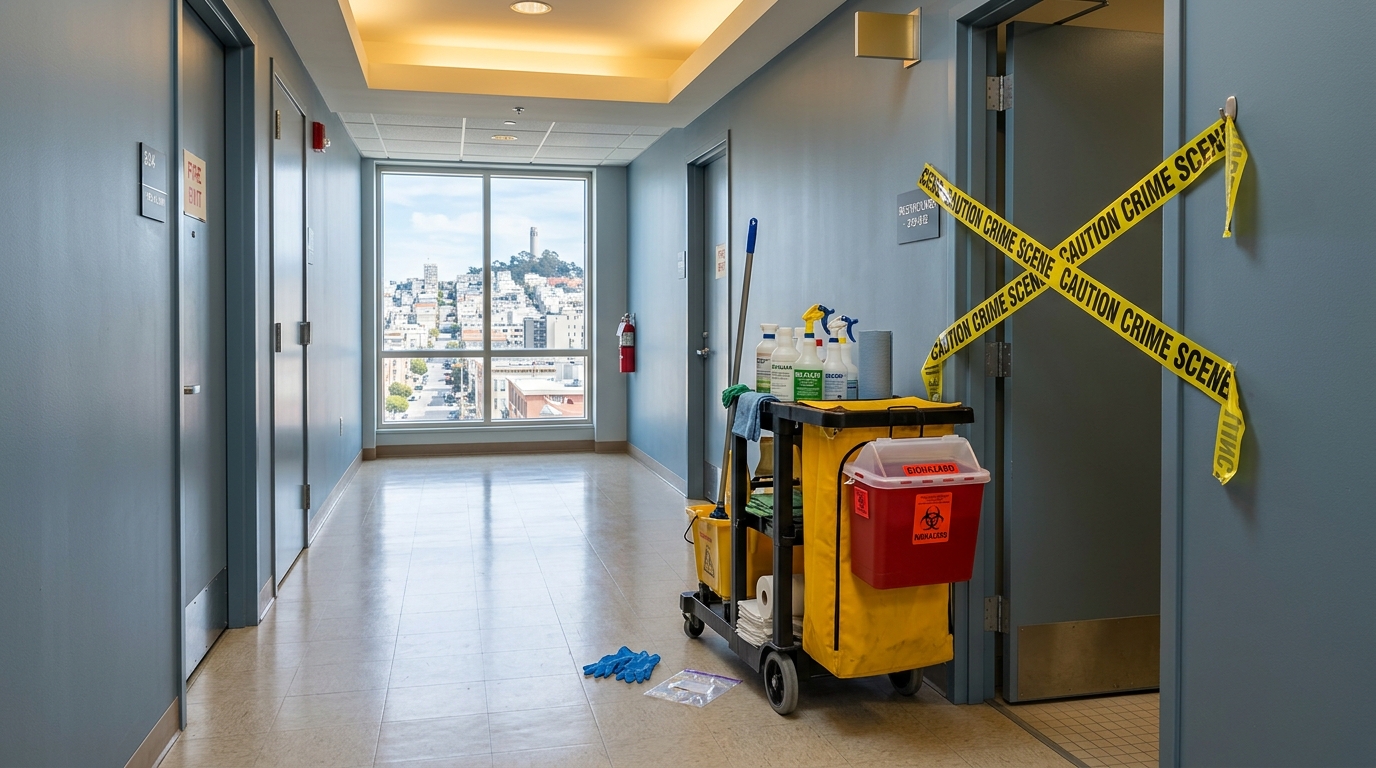
A crime scene can leave behind biological contamination that is not always visible to the eye. Blood, bodily fluids, and other potentially infectious materials may have migrated into carpet, padding, subflooring, baseboards, wallboard, or furniture — well beyond the boundaries of what you can see on the surface.
Crime scene cleanup in San Francisco begins only after the appropriate authority has officially released the scene. This is a firm boundary: no cleanup work can start while an active investigation is underway. Once released, our team coordinates with the authorized contact — whether that's a family member, property owner, landlord, building manager, or legal representative — to schedule a discreet on-site assessment.
San Francisco properties present their own considerations. Dense residential neighborhoods like Nob Hill or Russian Hill often involve multi-unit buildings with shared hallways, elevators, and entrances. A cleanup in one unit needs to be managed carefully to minimize disruption to neighbors and protect unaffected areas from cross-contamination. Older Victorian and Edwardian properties may have layered or porous finish materials that require extra evaluation during the assessment.
A thorough assessment goes beyond the obvious. We evaluate both visible contamination and areas where biological material may have migrated into concealed layers — beneath flooring, behind wall bases, or into structural cavities. The type and extent of contamination determines the appropriate scope of work.
Before any removal or cleaning begins, the affected area is isolated to prevent cross-contamination. Containment barriers, controlled access points, and appropriate personal protective equipment (PPE) are standard considerations. This is especially important in shared buildings where hallways, stairwells, or common areas may be adjacent to the work zone.
Not every affected item requires disposal. Accessible, compatible nonporous surfaces may sometimes be cleaned and disinfected effectively. However, deeply affected porous materials — carpet, padding, drywall, insulation, or upholstery — may require removal when contamination has penetrated beyond the surface. This determination is made during the assessment, not assumed in advance.
Each situation is different, but the general process follows a structured approach tailored to your property's specific conditions.
Cleanup begins only after the scene has been released by the appropriate authority. We coordinate with your designated contact to confirm release status before scheduling.
A detailed evaluation of visible and concealed contamination, affected materials, access conditions, and property layout. The assessment determines the scope of work and forms the basis for a written estimate.
Isolation of the affected area using containment barriers. Controlled access points are established, and protective measures are put in place for adjacent spaces — particularly important in San Francisco multi-unit buildings.
Materials that cannot be safely restored are removed. Compatible surfaces are cleaned and treated with appropriate disinfectants according to label directions and required contact times. Odor sources are addressed directly rather than masked with fragrance.
After cleanup is complete, a work-area review confirms the scope has been addressed. Documentation of the work performed is provided when requested. Coordination with restoration professionals is arranged separately when structural repairs are needed.
Apartments, condominiums, and mixed-use buildings in neighborhoods like SoMa or the Mission District require discreet scheduling, controlled entry, and service-elevator use where available to minimize disruption to other occupants.
We work directly with the authorized representative and maintain strict privacy throughout the process. Discreet arrival, unmarked equipment transport, and controlled access help protect your privacy and the dignity of the situation.
San Francisco's older housing stock — Victorians, Edwardians, and early 20th-century buildings — often features layered flooring, plaster walls, and original woodwork. Porous materials in these properties may require careful evaluation during assessment.
Our team respects all evidence-preservation boundaries established during the investigation. Cleanup addresses only areas that have been officially released and cleared for remediation work.
Depending on the incident, crime scene cleanup may involve addressing blood and bodily fluids, fingerprint powder residue, tear-gas residue, or other materials left behind during or after the investigation. Each of these requires a different approach to cleaning and disposal.
Biological fluids can move through carpet fibers, seep through padding into subflooring, travel along baseboards, and migrate into wall cavities. This migration often happens before the scene is discovered or released, meaning the visible contamination may represent only a portion of what needs to be addressed.
Porous materials like carpet, padding, certain types of upholstery, and wallboard absorb biological fluids differently than hard, nonporous surfaces. While a tile floor or sealed countertop may be cleaned and disinfected effectively, a carpet with padding that has absorbed contamination deep into the subfloor may need to be removed entirely.
We understand that the people contacting us are often dealing with an extremely difficult situation. Our communication is calm, clear, and respectful. We explain the assessment findings, the recommended scope of work, and the estimated timeline without unnecessary pressure.
For San Francisco rental properties, we coordinate directly with the authorized party — whether that's the tenant, the landlord, a property manager, or a legal representative. In commercial settings, we work around business hours and coordinate with building management to minimize impact on operations and neighboring tenants.
Cleanup can begin only after the appropriate authority — typically law enforcement or the medical examiner — has officially released the scene. Once released, we can schedule an on-site assessment promptly. Emergency assistance is available when capacity allows.
The scope depends on what the assessment reveals. Generally, it includes containment of the affected area, removal of materials that cannot be safely restored, cleaning and disinfection of compatible surfaces using products applied according to label directions, odor-source removal, and a final work-area review. Structural repairs or restoration are coordinated separately when needed.
Coverage depends on your specific policy, the cause of the incident, applicable exclusions, your deductible, documentation requirements, and the insurer's decision. We recommend contacting your insurance provider to discuss coverage before cleanup begins. Detailed estimates and documentation of completed work can be provided when requested.
The timeline depends on the size of the affected area, the type and extent of contamination, the materials involved, access conditions, and whether odor treatment or material removal is required. A realistic timeline is discussed after the on-site assessment.
Blood, bodily fluids, and other potentially infectious materials carry exposure risks. Professional assessment helps identify contamination that may not be visible, including material that has migrated into concealed layers. Avoid direct contact with affected areas and consult a qualified professional before attempting any cleanup.
